SAML V2.0
SAML version 2.0 was approved as an OASIS Standard in March 2005. Approved Errata for SAML V2.0 was last produced by the SSTC on 1 May 2012. In addition to the normative errata document, the following non-normative "errata composite" documents have been provided that combine the prescribed corrections with the original specification text, illustrating the changes with margin change bars, struck-through original text, and highlighted new text.
What is SAML?
Security Assertion Markup Language. It is an XML-based open-standard for transferring identity data between two parties: an identity provider (IdP) and a service provider (SP).
Identity Provider
Performs authentication and passes the user's identity and authorization level to the service provider. in this post we our Identity provider (IdP) realm was created on keycloak.
Service Provider
Trusts the identity provider and authorizes the given user to access the requested resource. in this post we our service provider was created on Spring boot and spring Security.
For more details I suggest you watch the Demystifying SAML Using Spring Security.

[Image]. SpringOne Platform
Downloading and installing Keycloak
docker run -p 8080:8080 -e KEYCLOAK_ADMIN=admin -e KEYCLOAK_ADMIN_PASSWORD=admin quay.io/keycloak/keycloak:18.0.1 start-devThis will start Keycloak exposed on the local port 8080. It will also create an initial admin user with username admin and password admin.
Setting Up a keycloack server.
Open a browser http://localhost:8080 or http://127.0.0.1:8080 result this.

We can now proceed to the Administrative Console.

Creating a Realm
For default the console opens up Master realm, Let's navigate left corner Add realm button.

For this example I created realm IDP_REALM. we'll click the button create.

For check your SAML 2.0 Identity Provider Metadata Click on

Result this:

This URL we need later for configuration in Spring boot.
http://localhost:8080/realms/IDP_REALM/protocol/saml/descriptor
Creating a Client

Add a new client with the name spring-boot-keycloak with Client Protocol saml. click button save.


Only add next values and then click button save.
Client ID: spring-boot-keycloakClient Protocol: samlSignature Algorithm: RSA_SHA256SAML Signature Key Name: KEY_IDCanonicalization Method: EXCLUSIVEName ID Format : usernameRoot URL: http://localhost:8081Valid Redirect URIs: /saml/*Base URL: /
**Fine Grain SAML Endpoint Configuration***Assertion Consumer Service POST Binding URL: /saml/SSOLogout Service POST Binding URL: /saml/logout

Go to Tab Keys, Click on Export

Export SAML Key: Type next Key Password and Store Password -> store123This password we need later for configuration in Spring boot.

Download and save. Later replace file in Spring Boot resources/saml folder keystore.jks

Client ID: spring-boot-keycloak
Client Protocol: saml
Signature Algorithm: RSA_SHA256
SAML Signature Key Name: KEY_ID
Canonicalization Method: EXCLUSIVE
Name ID Format : username
Root URL: http://localhost:8081
Valid Redirect URIs: /saml/*
Base URL: /
**Fine Grain SAML Endpoint Configuration***
Assertion Consumer Service POST Binding URL: /saml/SSO
Logout Service POST Binding URL: /saml/logout
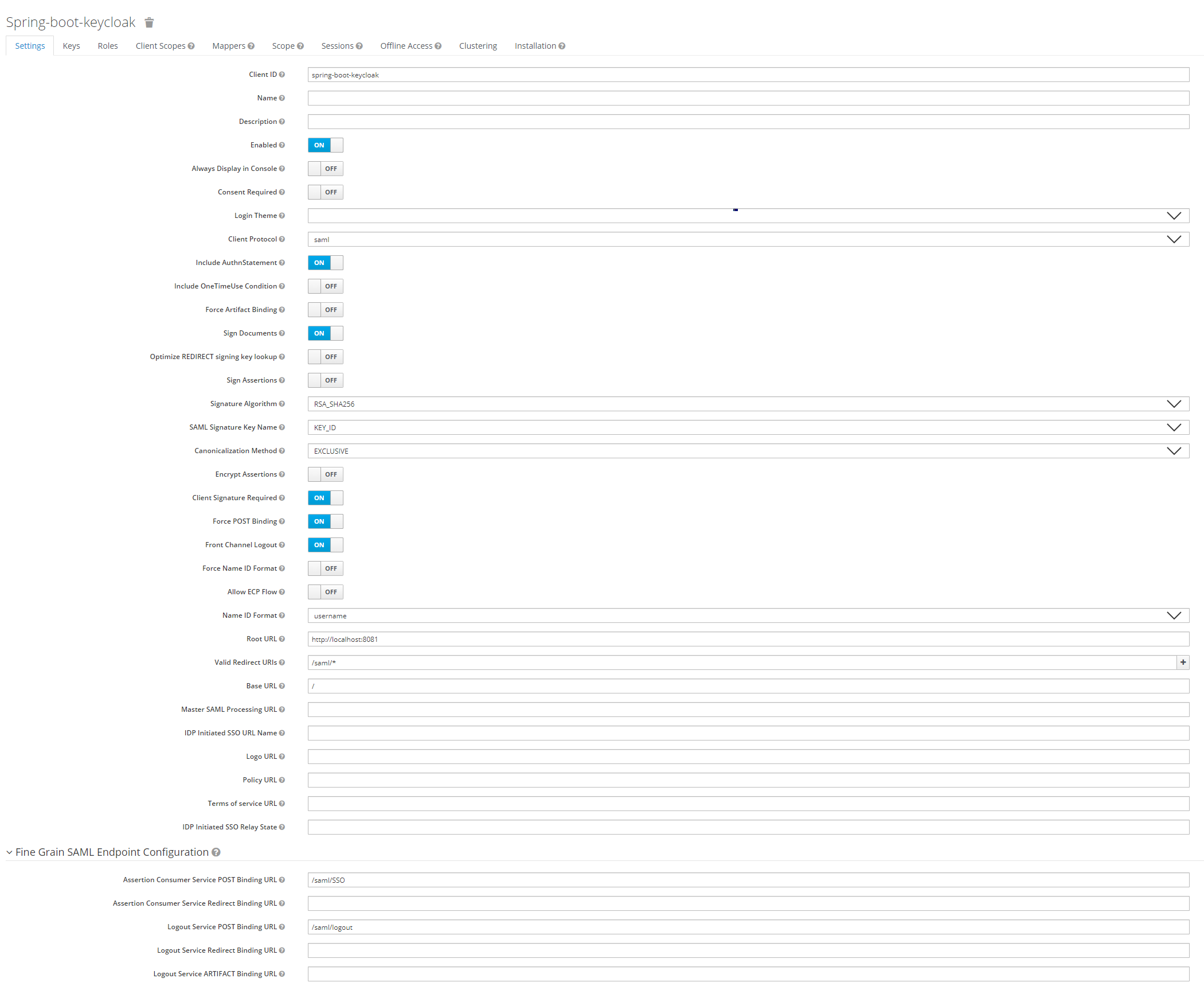
Go to Tab Keys, Click on Export

Export SAML Key: Type next Key Password and Store Password -> store123
This password we need later for configuration in Spring boot.
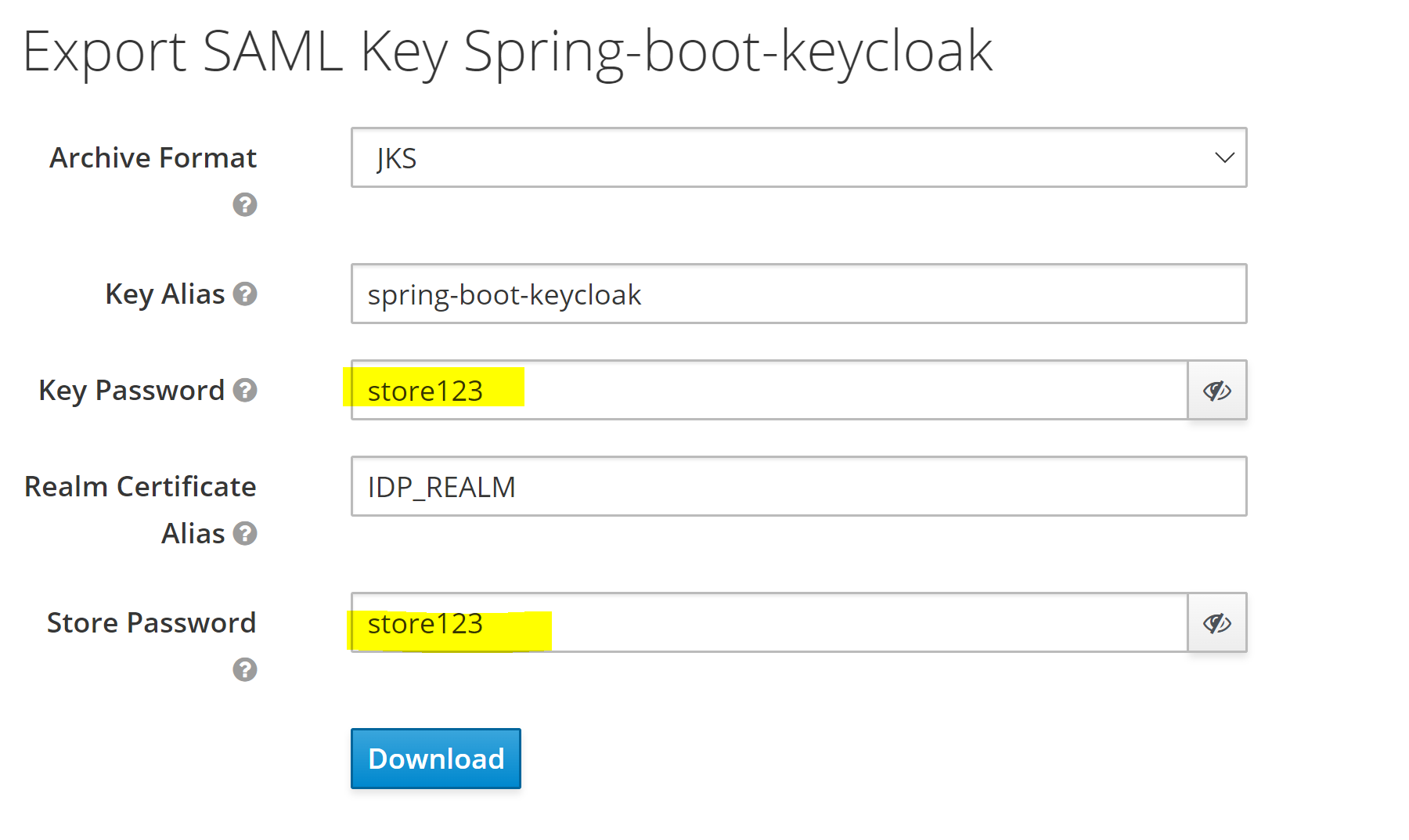
Download and save. Later replace file in Spring Boot resources/saml folder keystore.jks

Creating a Users
Add next user: user1 password user1


Add next user: user1 password user1


Creating a Spring Boot Application
We're integration SAML 2.0, Spring Boot, Security and keycloack.
- Configuration SAML 2.0, Spring Boot, Security and keycloack.
- Spring Controllers
We're integration SAML 2.0, Spring Boot, Security and keycloack.
- Configuration SAML 2.0, Spring Boot, Security and keycloack.
- Spring Controllers
Technology
- Spring Boot 2.7.3
- SAML 2.0
- Keycloak 18.0.1
- Thymeleaf
- Java 17 (Zulu)
- Docker
- Maven
- IntelliJ IDEA
- Spring Boot 2.7.3
- SAML 2.0
- Keycloak 18.0.1
- Thymeleaf
- Java 17 (Zulu)
- Docker
- Maven
- IntelliJ IDEA
Project Structure
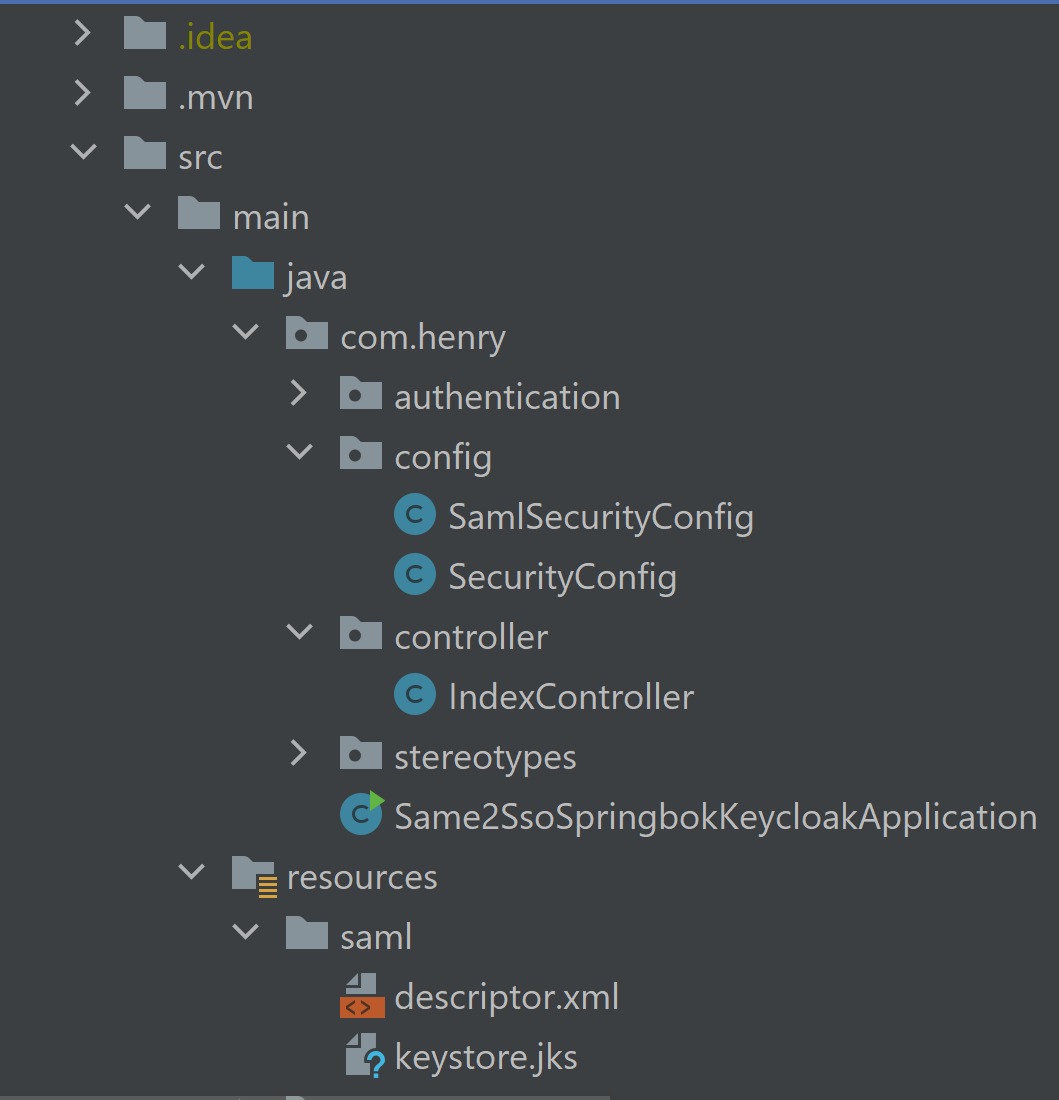
Configuration Spring Boot Keycloak project
- Spring Initializr or Spring Suite Tool (STS).
- Maven
- Spring Initializr or Spring Suite Tool (STS).
- Maven
pom.xml
<?xml version="1.0" encoding="UTF-8"?>
<project xmlns="http://maven.apache.org/POM/4.0.0" xmlns:xsi="http://www.w3.org/2001/XMLSchema-instance"
   xsi:schemaLocation="http://maven.apache.org/POM/4.0.0 https://maven.apache.org/xsd/maven-4.0.0.xsd">
   <modelVersion>4.0.0</modelVersion>
   <parent>
      <groupId>org.springframework.boot</groupId>
      <artifactId>spring-boot-starter-parent</artifactId>
      <version>2.7.3</version>
      <relativePath/> <!-- lookup parent from repository -->
   </parent>
   <groupId>com.henry</groupId>
   <artifactId>saml2-sso-springboot-keycloak</artifactId>
   <version>0.0.1-SNAPSHOT</version>
   <name>saml2-sso-springboot-keycloak</name>
   <description>Demo project for Spring Boot</description>
   <properties>
      <java.version>17</java.version>
   </properties>

   <dependencies>
      <dependency>
         <groupId>org.springframework.boot</groupId>
         <artifactId>spring-boot-starter-web</artifactId>
      </dependency>
      <dependency>
         <groupId>org.springframework.boot</groupId>
         <artifactId>spring-boot-starter-security</artifactId>
      </dependency>
      <dependency>
         <groupId>org.springframework.boot</groupId>
         <artifactId>spring-boot-starter-thymeleaf</artifactId>
      </dependency>
      <dependency>
         <groupId>org.springframework.security.extensions</groupId>
         <artifactId>spring-security-saml2-core</artifactId>
         <version>1.0.10.RELEASE</version>
      </dependency>
   </dependencies>

   <repositories>
      <repository>
         <id>Shibboleth</id>
         <name>Shibboleth</name>
         <url>https://build.shibboleth.net/nexus/content/repositories/releases/</url>
      </repository>
   </repositories>
   <build>
      <plugins>
         <plugin>
            <groupId>org.springframework.boot</groupId>
            <artifactId>spring-boot-maven-plugin</artifactId>
         </plugin>
         <plugin>
            <groupId>org.apache.maven.plugins</groupId>
            <artifactId>maven-resources-plugin</artifactId>
            <version>3.1.0</version>
         </plugin>
      </plugins>
   </build>

</project>
application.yml:
server:
  port: 8081
  servlet:
    context-path: /
spring:
  main:
    allow-circular-references: true

keycloak:
  client: spring-boot-keycloak

saml:
  keystore:
    path: classpath:/saml/keystore.jks
    password: store123
    alias: spring-boot-keycloak
  url:
    descriptor: http://localhost:8080/realms/IDP_REALM/protocol/saml/descriptor
Stereotypes
package com.henry.stereotypes;

import java.lang.annotation.Documented;
import java.lang.annotation.Retention;
import java.lang.annotation.Target;
import java.lang.annotation.ElementType;
import java.lang.annotation.RetentionPolicy;

@Target(ElementType.PARAMETER)
@Retention(RetentionPolicy.RUNTIME)
@Documented
public @interface CurrentUser {}
Authentication
package com.henry.authentication;

import java.security.Principal;

import com.henry.stereotypes.CurrentUser;
import org.springframework.core.MethodParameter;
import org.springframework.security.core.Authentication;
import org.springframework.security.core.userdetails.User;
import org.springframework.stereotype.Component;
import org.springframework.web.bind.support.WebArgumentResolver;
import org.springframework.web.bind.support.WebDataBinderFactory;
import org.springframework.web.context.request.NativeWebRequest;
import org.springframework.web.method.support.HandlerMethodArgumentResolver;
import org.springframework.web.method.support.ModelAndViewContainer;

@Component
public class CurrentUserHandlerMethodArgumentResolver implements
        HandlerMethodArgumentResolver {

    public boolean supportsParameter(MethodParameter methodParameter) {
        return methodParameter.getParameterAnnotation(CurrentUser.class) != null
                && methodParameter.getParameterType().equals(User.class);
    }

    public Object resolveArgument(MethodParameter methodParameter,
                                  ModelAndViewContainer mavContainer, NativeWebRequest webRequest,
                                  WebDataBinderFactory binderFactory) throws Exception {
        if (this.supportsParameter(methodParameter)) {
            Principal principal = (Principal) webRequest.getUserPrincipal();
            return (User) ((Authentication) principal).getPrincipal();
        } else {
            return WebArgumentResolver.UNRESOLVED;
        }
    }
}
package com.henry.authentication;

import java.util.List;

import org.springframework.beans.factory.annotation.Autowired;
import org.springframework.context.annotation.Configuration;
import org.springframework.web.method.support.HandlerMethodArgumentResolver;
import org.springframework.web.servlet.config.annotation.ResourceHandlerRegistry;
import org.springframework.web.servlet.config.annotation.ViewControllerRegistry;
import org.springframework.web.servlet.config.annotation.WebMvcConfigurer;


@Configuration
public class MvcConfig implements WebMvcConfigurer {

    @Autowired
    CurrentUserHandlerMethodArgumentResolver currentUserHandlerMethodArgumentResolver;

    @Override
    public void addViewControllers(ViewControllerRegistry registry) {

    }

    @Override
    public void addResourceHandlers(ResourceHandlerRegistry registry) {
        if (!registry.hasMappingForPattern("/static/**")) {
            registry.addResourceHandler("/static/**")
                    .addResourceLocations("/static/");
        }
    }

    @Override
    public void addArgumentResolvers(List<HandlerMethodArgumentResolver> argumentResolvers){
        argumentResolvers.add(currentUserHandlerMethodArgumentResolver);
    }

}
package com.henry.authentication;

import java.util.ArrayList;
import java.util.List;

import org.slf4j.Logger;
import org.slf4j.LoggerFactory;
import org.springframework.security.core.GrantedAuthority;
import org.springframework.security.core.authority.SimpleGrantedAuthority;
import org.springframework.security.core.userdetails.User;
import org.springframework.security.core.userdetails.UsernameNotFoundException;
import org.springframework.security.saml.SAMLCredential;
import org.springframework.security.saml.userdetails.SAMLUserDetailsService;
import org.springframework.stereotype.Service;

@Service
public class SAMLUserDetailsServiceImpl implements SAMLUserDetailsService {

    // Logger
    private static final Logger LOG = LoggerFactory.getLogger(SAMLUserDetailsServiceImpl.class);

    public Object loadUserBySAML(SAMLCredential credential)
            throws UsernameNotFoundException {

        // The method is supposed to identify local account of user referenced by
        // data in the SAML assertion and return UserDetails object describing the user.

        String userID = credential.getNameID().getValue();

        LOG.info(userID + " is logged in");
        List<GrantedAuthority> authorities = new ArrayList<GrantedAuthority>();
        GrantedAuthority authority = new SimpleGrantedAuthority("ROLE_USER");
        authorities.add(authority);

        // In a real scenario, this implementation has to locate user in a arbitrary
        // dataStore based on information present in the SAMLCredential and
        // returns such a date in a form of application specific UserDetails object.
        return new User(userID, "<abc123>", true, true, true, true, authorities);
    }

}
Config
package com.henry.config;

import com.henry.authentication.SAMLUserDetailsServiceImpl;
import org.apache.commons.httpclient.HttpClient;
import org.apache.commons.httpclient.MultiThreadedHttpConnectionManager;
import org.apache.velocity.app.VelocityEngine;
import org.opensaml.saml2.metadata.provider.HTTPMetadataProvider;
import org.opensaml.saml2.metadata.provider.MetadataProvider;
import org.opensaml.saml2.metadata.provider.MetadataProviderException;
import org.opensaml.xml.parse.ParserPool;
import org.opensaml.xml.parse.StaticBasicParserPool;
import org.springframework.beans.factory.annotation.Autowired;
import org.springframework.beans.factory.annotation.Qualifier;
import org.springframework.beans.factory.annotation.Value;
import org.springframework.context.annotation.Bean;
import org.springframework.context.annotation.Configuration;
import org.springframework.core.io.DefaultResourceLoader;
import org.springframework.core.io.Resource;
import org.springframework.security.saml.*;
import org.springframework.security.saml.context.SAMLContextProviderImpl;
import org.springframework.security.saml.key.JKSKeyManager;
import org.springframework.security.saml.key.KeyManager;
import org.springframework.security.saml.log.SAMLDefaultLogger;
import org.springframework.security.saml.metadata.CachingMetadataManager;
import org.springframework.security.saml.metadata.ExtendedMetadata;
import org.springframework.security.saml.metadata.ExtendedMetadataDelegate;
import org.springframework.security.saml.processor.*;
import org.springframework.security.saml.util.VelocityFactory;
import org.springframework.security.saml.websso.*;
import org.springframework.security.web.authentication.SavedRequestAwareAuthenticationSuccessHandler;
import org.springframework.security.web.authentication.SimpleUrlAuthenticationFailureHandler;
import org.springframework.security.web.authentication.logout.LogoutHandler;
import org.springframework.security.web.authentication.logout.SecurityContextLogoutHandler;
import org.springframework.security.web.authentication.logout.SimpleUrlLogoutSuccessHandler;

import java.util.*;

@Configuration
public class SamlSecurityConfig {

    @Value("${saml.keystore.path}")
    private String samlKeystorePath;

    @Value("${saml.keystore.password}")
    private String samlKeystorePassword;

    @Value("${saml.keystore.alias}")
    private String samlKeystoreAlias;

    @Value("${saml.url.descriptor}")
    private String samlUrlDescriptor;

    @Autowired
    private SAMLUserDetailsServiceImpl samlUserDetailsServiceImpl;

    private MultiThreadedHttpConnectionManager multiThreadedHttpConnectionManager;

    // Initialization of OpenSAML library
    @Bean
    public static SAMLBootstrap sAMLBootstrap() {
        return new SAMLBootstrap();
    }

    // Initialization of the velocity engine
    @Bean
    public VelocityEngine velocityEngine() {
        return VelocityFactory.getEngine();
    }

    @Bean(initMethod = "initialize")
    public StaticBasicParserPool parserPool() {
        return new StaticBasicParserPool();
    }

    @Bean
    public HttpClient httpClient() {
        this.multiThreadedHttpConnectionManager = new MultiThreadedHttpConnectionManager();
        return new HttpClient(this.multiThreadedHttpConnectionManager);
    }

    @Bean
    public SAMLAuthenticationProvider samlAuthenticationProvider() {
        SAMLAuthenticationProvider samlAuthenticationProvider = new SAMLAuthenticationProvider();
        samlAuthenticationProvider.setUserDetails(samlUserDetailsServiceImpl);
        samlAuthenticationProvider.setForcePrincipalAsString(false);
        return samlAuthenticationProvider;
    }

    // Provider of default SAML Context
    @Bean
    public SAMLContextProviderImpl contextProvider() {
        return new SAMLContextProviderImpl();
    }

    // Logger for SAML messages and events
    @Bean
    public SAMLDefaultLogger samlLogger() {
        return new SAMLDefaultLogger();
    }

    // SAML 2.0 WebSSO Assertion Consumer
    @Bean
    public WebSSOProfileConsumer webSSOprofileConsumer() {
        return new WebSSOProfileConsumerImpl();
    }

    // SAML 2.0 Holder-of-Key Web SSO profile
    @Bean
    public WebSSOProfileConsumerHoKImpl hokWebSSOProfile() {
        return new WebSSOProfileConsumerHoKImpl();
    }

    // SAML 2.0 Web SSO profile
    @Bean
    public WebSSOProfile webSSOprofile() {
        return new WebSSOProfileImpl();
    }

    // SAML 2.0 Holder-of-Key WebSSO Assertion Consumer
    @Bean
    public WebSSOProfileConsumerHoKImpl hokWebSSOprofileConsumer() {
        return new WebSSOProfileConsumerHoKImpl();
    }

    // SAML 2.0 ECP profile
    @Bean
    public WebSSOProfileECPImpl ecpprofile() {
        return new WebSSOProfileECPImpl();
    }

    @Bean
    public SingleLogoutProfile logoutprofile() {
        return new SingleLogoutProfileImpl();
    }

    // Central storage of cryptographic keys
    @Bean
    public KeyManager keyManager() {
        DefaultResourceLoader loader = new DefaultResourceLoader();
        Resource storeFile = loader
                .getResource(samlKeystorePath);
        String storePass = samlKeystorePassword;
        Map<String, String> passwords = new HashMap<String, String>();
        passwords.put(samlKeystoreAlias, samlKeystorePassword);
        String defaultKey = samlKeystoreAlias;
        return new JKSKeyManager(storeFile, storePass, passwords, defaultKey);
    }

    @Bean
    public WebSSOProfileOptions defaultWebSSOProfileOptions() {
        WebSSOProfileOptions webSSOProfileOptions = new WebSSOProfileOptions();
        webSSOProfileOptions.setIncludeScoping(false);
        return webSSOProfileOptions;
    }

    @Bean
    public SAMLEntryPoint samlEntryPoint() {
        SAMLEntryPoint samlEntryPoint = new SAMLEntryPoint();
        samlEntryPoint.setDefaultProfileOptions(defaultWebSSOProfileOptions());
        return samlEntryPoint;
    }

    @Bean
    public ExtendedMetadata extendedMetadata() {
        ExtendedMetadata extendedMetadata = new ExtendedMetadata();
        extendedMetadata.setIdpDiscoveryEnabled(false);
        extendedMetadata.setSignMetadata(false);
        return extendedMetadata;
    }

    /**
     * Access metadata by URL.
     * */

   @Bean
    @Qualifier("idp-keycloak")
    public ExtendedMetadataDelegate keycloakExtendedMetadataProvider()
            throws MetadataProviderException {
        String idpSSOKeycloakMetadataURL = samlUrlDescriptor;

        Timer timer = new Timer("saml-metadata");

        HTTPMetadataProvider httpMetadataProvider = new HTTPMetadataProvider(
                timer, httpClient(), idpSSOKeycloakMetadataURL);
        httpMetadataProvider.setParserPool(parserPool());
        ExtendedMetadataDelegate extendedMetadataDelegate =
                new ExtendedMetadataDelegate(httpMetadataProvider, extendedMetadata());
        extendedMetadataDelegate.setMetadataTrustCheck(true);
        extendedMetadataDelegate.setMetadataRequireSignature(false);
        return extendedMetadataDelegate;
    }

    /**
     * Access metadata XML FILE.
     * */
/*
    @Bean
    @Qualifier("idp-keycloak")
    public ExtendedMetadataDelegate keycloakExtendedMetadataProvider() throws MetadataProviderException {

        org.opensaml.util.resource.Resource resource = null;

        try {
            resource = new ClasspathResource("/saml/descriptor.xml");
        } catch (ResourceException e) {
            e.printStackTrace();
        }

        Timer timer = new Timer("saml-metadata");
        ResourceBackedMetadataProvider provider = new ResourceBackedMetadataProvider(timer,resource);
        provider.setParserPool(parserPool());
        return new ExtendedMetadataDelegate(provider, extendedMetadata());
    }
*/
    @Bean
    @Qualifier("metadata")
    public CachingMetadataManager metadata() throws MetadataProviderException {
        List<MetadataProvider> providers = new ArrayList<MetadataProvider>();
        providers.add(keycloakExtendedMetadataProvider());
        return new CachingMetadataManager(providers);
    }

    @Bean
    public SavedRequestAwareAuthenticationSuccessHandler successRedirectHandler() {
        SavedRequestAwareAuthenticationSuccessHandler successRedirectHandler =
                new SavedRequestAwareAuthenticationSuccessHandler();
        successRedirectHandler.setDefaultTargetUrl("/landing");
        return successRedirectHandler;
    }

    @Bean
    public SimpleUrlAuthenticationFailureHandler authenticationFailureHandler() {
        SimpleUrlAuthenticationFailureHandler failureHandler =
                new SimpleUrlAuthenticationFailureHandler();
        failureHandler.setUseForward(true);
        failureHandler.setDefaultFailureUrl("/error");
        return failureHandler;
    }

    @Bean
    public SimpleUrlLogoutSuccessHandler successLogoutHandler() {
        SimpleUrlLogoutSuccessHandler successLogoutHandler = new SimpleUrlLogoutSuccessHandler();
        successLogoutHandler.setDefaultTargetUrl("/");
        return successLogoutHandler;
    }

    @Bean
    public SecurityContextLogoutHandler logoutHandler() {
        SecurityContextLogoutHandler logoutHandler =
                new SecurityContextLogoutHandler();
        logoutHandler.setInvalidateHttpSession(true);
        logoutHandler.setClearAuthentication(true);
        return logoutHandler;
    }

    @Bean
    public SAMLLogoutProcessingFilter samlLogoutProcessingFilter() {
        return new SAMLLogoutProcessingFilter(successLogoutHandler(),
                logoutHandler());
    }

    @Bean
    public SAMLLogoutFilter samlLogoutFilter() {
        return new SAMLLogoutFilter(successLogoutHandler(),
                new LogoutHandler[]{logoutHandler()},
                new LogoutHandler[]{logoutHandler()});
    }

    @Bean
    public HTTPPostBinding httpPostBinding() {
        return new HTTPPostBinding(parserPool(), velocityEngine());
    }

    @Bean
    public HTTPRedirectDeflateBinding httpRedirectDeflateBinding() {
        return new HTTPRedirectDeflateBinding(parserPool());
    }

    // Bindings
    private ArtifactResolutionProfile artifactResolutionProfile() {
        final ArtifactResolutionProfileImpl artifactResolutionProfile =
                new ArtifactResolutionProfileImpl(httpClient());
        artifactResolutionProfile.setProcessor(new SAMLProcessorImpl(soapBinding()));
        return artifactResolutionProfile;
    }

    @Bean
    public HTTPArtifactBinding artifactBinding(ParserPool parserPool, VelocityEngine velocityEngine) {
        return new HTTPArtifactBinding(parserPool, velocityEngine, artifactResolutionProfile());
    }

    @Bean
    public HTTPSOAP11Binding soapBinding() {
        return new HTTPSOAP11Binding(parserPool());
    }

    @Bean
    public HTTPSOAP11Binding httpSOAP11Binding() {
        return new HTTPSOAP11Binding(parserPool());
    }

    @Bean
    public HTTPPAOS11Binding httpPAOS11Binding() {
        return new HTTPPAOS11Binding(parserPool());
    }

    // Processor
    @Bean
    public SAMLProcessorImpl processor() {
        Collection<SAMLBinding> bindings = new ArrayList<SAMLBinding>();
        bindings.add(httpRedirectDeflateBinding());
        bindings.add(httpPostBinding());
        bindings.add(artifactBinding(parserPool(), velocityEngine()));
        bindings.add(httpSOAP11Binding());
        bindings.add(httpPAOS11Binding());
        return new SAMLProcessorImpl(bindings);
    }

}
package com.henry.config;

import org.springframework.beans.factory.annotation.Autowired;
import org.springframework.beans.factory.annotation.Value;
import org.springframework.context.annotation.Bean;
import org.springframework.context.annotation.Configuration;
import org.springframework.security.authentication.AuthenticationManager;
import org.springframework.security.config.annotation.authentication.builders.AuthenticationManagerBuilder;
import org.springframework.security.config.annotation.method.configuration.EnableGlobalMethodSecurity;
import org.springframework.security.config.annotation.web.builders.HttpSecurity;
import org.springframework.security.config.annotation.web.configuration.EnableWebSecurity;
import org.springframework.security.saml.*;
import org.springframework.security.saml.key.KeyManager;
import org.springframework.security.saml.metadata.ExtendedMetadata;
import org.springframework.security.saml.metadata.MetadataDisplayFilter;
import org.springframework.security.saml.metadata.MetadataGenerator;
import org.springframework.security.saml.metadata.MetadataGeneratorFilter;
import org.springframework.security.saml.parser.ParserPoolHolder;
import org.springframework.security.saml.trust.httpclient.TLSProtocolConfigurer;
import org.springframework.security.web.DefaultSecurityFilterChain;
import org.springframework.security.web.FilterChainProxy;
import org.springframework.security.web.SecurityFilterChain;
import org.springframework.security.web.access.channel.ChannelProcessingFilter;
import org.springframework.security.web.authentication.SavedRequestAwareAuthenticationSuccessHandler;
import org.springframework.security.web.authentication.SimpleUrlAuthenticationFailureHandler;
import org.springframework.security.web.authentication.www.BasicAuthenticationFilter;
import org.springframework.security.web.csrf.CsrfFilter;
import org.springframework.security.web.util.matcher.AntPathRequestMatcher;

import java.util.ArrayList;
import java.util.List;


@Configuration
@EnableWebSecurity
@EnableGlobalMethodSecurity(prePostEnabled = true)
public class SecurityConfig {

    @Value("${keycloak.client}")
    private String keycloakClient;
    @Autowired
    private SAMLEntryPoint samlEntryPoint;
    @Autowired
    private ExtendedMetadata extendedMetadata;
    @Autowired
    private SavedRequestAwareAuthenticationSuccessHandler successRedirectHandler;
    @Autowired
    private SAMLLogoutProcessingFilter samlLogoutProcessingFilter;
    @Autowired
    private SimpleUrlAuthenticationFailureHandler authenticationFailureHandler;
    @Autowired
    private SAMLLogoutFilter samlLogoutFilter;
    @Autowired
    private SAMLAuthenticationProvider samlAuthenticationProvider;

    @Autowired
    private KeyManager keyManager;

    @Bean(name = "parserPoolHolder")
    public ParserPoolHolder parserPoolHolder() {
        return new ParserPoolHolder();
    }


    // Setup TLS Socket Factory
    @Bean
    public TLSProtocolConfigurer tlsProtocolConfigurer() {
        return new TLSProtocolConfigurer();
    }

    @Bean
    public SAMLDiscovery samlIDPDiscovery() {
        SAMLDiscovery idpDiscovery = new SAMLDiscovery();
        return idpDiscovery;
    }

    @Bean
    public MetadataGenerator metadataGenerator() {
        MetadataGenerator metadataGenerator = new MetadataGenerator();
        metadataGenerator.setEntityId(keycloakClient);
        metadataGenerator.setExtendedMetadata(extendedMetadata);
        metadataGenerator.setIncludeDiscoveryExtension(false);
        metadataGenerator.setKeyManager(keyManager);
        return metadataGenerator;
    }

    @Bean
    public MetadataDisplayFilter metadataDisplayFilter() {
        return new MetadataDisplayFilter();
    }

    @Bean
    public SAMLWebSSOHoKProcessingFilter samlWebSSOHoKProcessingFilter(HttpSecurity http) throws Exception {
        SAMLWebSSOHoKProcessingFilter samlWebSSOHoKProcessingFilter = new SAMLWebSSOHoKProcessingFilter();
        samlWebSSOHoKProcessingFilter.setAuthenticationSuccessHandler(successRedirectHandler);
        samlWebSSOHoKProcessingFilter.setAuthenticationManager(authenticationManagerBean(http));
        samlWebSSOHoKProcessingFilter.setAuthenticationFailureHandler(authenticationFailureHandler);
        return samlWebSSOHoKProcessingFilter;
    }

    @Bean
    public SAMLProcessingFilter samlWebSSOProcessingFilter(HttpSecurity http) throws Exception {
        SAMLProcessingFilter samlWebSSOProcessingFilter = new SAMLProcessingFilter();
        samlWebSSOProcessingFilter.setAuthenticationManager(authenticationManagerBean(http));
        samlWebSSOProcessingFilter.setAuthenticationSuccessHandler(successRedirectHandler);
        samlWebSSOProcessingFilter.setAuthenticationFailureHandler(authenticationFailureHandler);
        return samlWebSSOProcessingFilter;
    }

    @Bean
    public MetadataGeneratorFilter metadataGeneratorFilter() {
        return new MetadataGeneratorFilter(metadataGenerator());
    }

    @Bean
    public FilterChainProxy samlFilter(HttpSecurity http) throws Exception {
        List<SecurityFilterChain> chains = new ArrayList<SecurityFilterChain>();
        chains.add(new DefaultSecurityFilterChain(new AntPathRequestMatcher("/saml/login/**"),
                samlEntryPoint));
        chains.add(new DefaultSecurityFilterChain(new AntPathRequestMatcher("/saml/logout/**"),
                samlLogoutFilter));
        chains.add(new DefaultSecurityFilterChain(new AntPathRequestMatcher("/saml/metadata/**"),
                metadataDisplayFilter()));
        chains.add(new DefaultSecurityFilterChain(new AntPathRequestMatcher("/saml/SSO/**"),
                samlWebSSOProcessingFilter(http)));
        chains.add(new DefaultSecurityFilterChain(new AntPathRequestMatcher("/saml/SSOHoK/**"),
                samlWebSSOHoKProcessingFilter(http)));
        chains.add(new DefaultSecurityFilterChain(new AntPathRequestMatcher("/saml/SingleLogout/**"),
                samlLogoutProcessingFilter));
        chains.add(new DefaultSecurityFilterChain(new AntPathRequestMatcher("/saml/discovery/**"),
                samlIDPDiscovery()));
        return new FilterChainProxy(chains);
    }

    @Bean
    public AuthenticationManager authenticationManagerBean(HttpSecurity http) throws Exception {
        AuthenticationManagerBuilder authenticationManagerBuilder = http.getSharedObject(AuthenticationManagerBuilder.class);
        authenticationManagerBuilder.authenticationProvider(samlAuthenticationProvider);
        return authenticationManagerBuilder.build();
    }

    @Bean
    public SecurityFilterChain filterChain(HttpSecurity http) throws Exception {

        http
                .httpBasic()
                .authenticationEntryPoint(samlEntryPoint);
        http
                .addFilterBefore(metadataGeneratorFilter(), ChannelProcessingFilter.class)
                .addFilterAfter(samlFilter(http), BasicAuthenticationFilter.class)
                .addFilterBefore(samlFilter(http), CsrfFilter.class);
        http
                .authorizeRequests()
                .antMatchers("/").permitAll()
                .antMatchers("/saml/**").permitAll()
                //.antMatchers("/css/**").permitAll()
                //.antMatchers("/img/**").permitAll()
                //.antMatchers("/js/**").permitAll()
                .anyRequest().authenticated();
        http
                .logout()
                .disable();    // The logout procedure is already handled by SAML filters.
        return http.build();
    }

}
Controller
package com.henry.controller;

import com.henry.stereotypes.CurrentUser;
import org.slf4j.Logger;
import org.slf4j.LoggerFactory;
import org.springframework.beans.factory.annotation.Autowired;
import org.springframework.security.core.Authentication;
import org.springframework.security.core.context.SecurityContextHolder;
import org.springframework.security.core.userdetails.User;
import org.springframework.security.saml.metadata.MetadataManager;
import org.springframework.stereotype.Controller;
import org.springframework.ui.Model;
import org.springframework.web.bind.annotation.RequestMapping;

import javax.servlet.http.HttpServletRequest;

@Controller
public class IndexController {

   // Logger
   private static final Logger LOG = LoggerFactory
         .getLogger(IndexController.class);

   @Autowired
   private MetadataManager metadata;

   @RequestMapping("/")
   public String index(HttpServletRequest request, Model model) {
      return "index";
   }

   @RequestMapping("/landing")
   public String landing(@CurrentUser User user, Model model) {
      Authentication auth = SecurityContextHolder.getContext().getAuthentication();
      if (auth == null)
         LOG.debug("Current authentication instance from security context is null");
      else
         LOG.debug("Current authentication instance from security context: "
               + this.getClass().getSimpleName());
      model.addAttribute("username",     user.getUsername());
      return "landing";
   }

}
Replace keystore.jks with your keystore.
Note: There are two ways to access ExtendedMetadataDelegate: By Url or XML File in both cases you need to access by IDP_REALM was created on keycloak.
http://localhost:8080/realms/IDP_REALM/protocol/saml/descriptor
In this post we used a URL, however if you want to XML File then download from URL and save with the name descriptor.xml and it will replace the Spring boot resources. and uncomment the method in the class SamlSecurityConfig -> ExtendedMetadataDelegate, however just one method should be enabled.

Run & Test
Run Spring Boot application with command: mvn spring-boot:run. by console or IntelliJ etc.

Open a browser http://localhost:8081 result this.

Click on Login button, result this.
Set username user1 and password user1 , keycloak suggest to you to change the password,
In this example I set the same password.


And resul this.
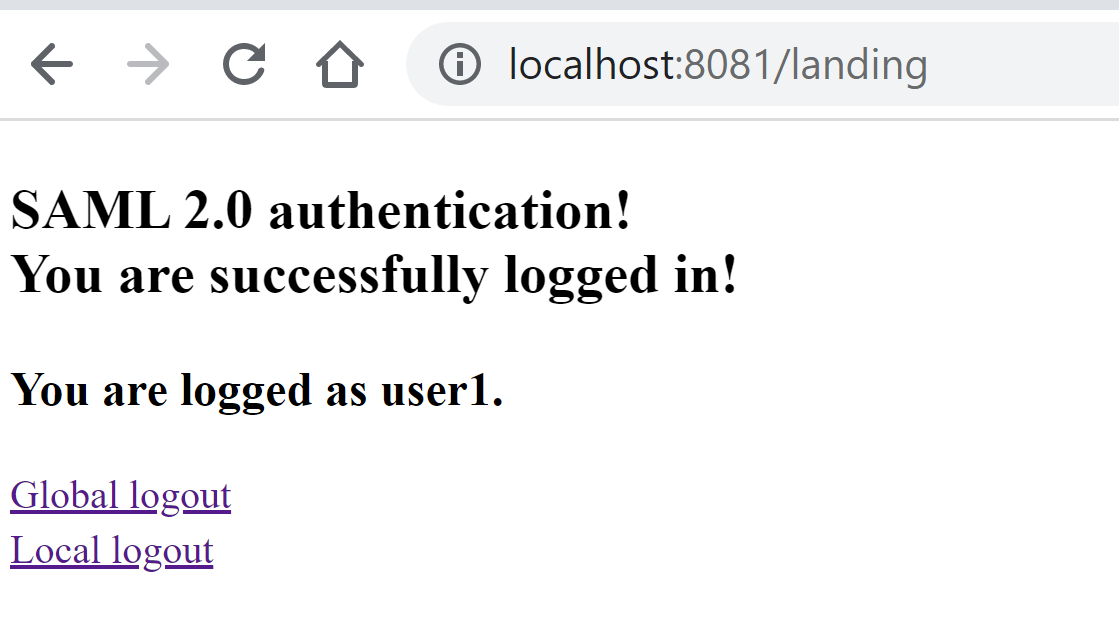
Global logout back the login.
References:
https://stackoverflow.com/questions/71605941/spring-security-global-authenticationmanager-without-the-websecurityconfigurera
https://spring.io/blog/2022/02/21/spring-security-without-the-websecurityconfigureradapter
https://www.baeldung.com/spring-deprecated-websecurityconfigureradapter
https://github.com/eugenp/tutorials/tree/master/spring-security-modules/spring-security-saml
https://www.baeldung.com/spring-security-saml
https://blog.codecentric.de/en/2019/03/secure-spring-boot-app-saml-keycloak/
https://github.com/thomasdarimont/spring-boot-security-saml-sample
https://www.youtube.com/watch?v=SvppXbpv-5k
https://www.youtube.com/watch?v=PruyokKaJWw&t=586s
https://codetinkering.com/spring-security-saml2-service-provider-example/
https://codetinkering.com/saml2-spring-security-5-2-tutorial/
https://auth0.com/blog/how-saml-authentication-works/
https://github.com/fhanik/springone2018
https://www.youtube.com/watch?v=JBAKnJ9Obvw&t=21s


